The BriefIssue 02
Eight questions to ask before they leave treatment.
The discharge meeting is the one time the family, the client and the clinical team sit down together. Most families walk in without a list. Here is one worth bringing, and the research behind every question.
The short version
Somewhere in the last week of treatment, the family gets invited to a meeting. A counselor walks through the plan, someone asks about the drive home, and it is over quickly. Then the person comes home, and the questions the family should have asked start showing up at eleven at night.
That meeting is the best chance the family will get to shape what happens next. The research below says the same thing from eight different directions: the plans that hold up are specific. A name, a date, a kit in the cabinet, a signed form. Here is what to ask, and what a good answer sounds like.
Before you walk in
People forget 40 to 80% of what a clinician tells them, and about half of what they do remember is wrong. Bring this list. Write the answers down in the room. Ask for the plan in writing, with names and dates on it.
The eight questions, and what a good answer sounds like
01/The first appointmentWhen is the first outpatient appointment, and who booked it?
Plenty of discharge plans end with a phone number and the words “call to schedule.” What happens next is not encouraging. In a study of 18,793 Medicaid patients leaving psychiatric units, people with no history of outpatient care were about three times more likely to show up within 7 days if the appointment was already on the calendar when they walked out.
Showing up matters more than it sounds. Among 10,064 veterans leaving residential addiction treatment, those seen by an outpatient addiction provider within 14 days had 23% lower odds of dying over the next two years.
What a good answer sounds like
A provider’s name, a date and time within 7 days, an address, and a plan for how they will get there.
With AlongsideAdmission and Discharge Planning books and confirms the first appointments. Private Transport gets the client to them.
02/The record and the releasesWill the next provider actually have the record, and will you?
There are two separate problems here. The first is between providers. In hospital medicine, where this has been studied closely, the discharge summary reaches the next doctor by the first follow-up visit only 12 to 34% of the time, and the two doctors speak directly in 3 to 20% of cases. Addiction treatment has no reason to think it does better.
The second problem is the family. Federal law (42 CFR Part 2) protects addiction treatment records more tightly than almost any other medical record. Without a signed release naming you, the outpatient provider cannot tell you whether your son went to his appointment. Since the 2024 rule change, one consent can cover future treatment-related sharing, so there is no reason to leave the meeting without it.
What a good answer sounds like
Releases signed today, naming the outpatient provider, the prescriber and the specific family members who will be checking in.
With AlongsideA Lead Advisor is the single point of contact, with releases in place, so the family, the treatment team and the outpatient provider are all working from the same plan.
03/MedicationIs a medication part of the plan, and who prescribes it after today?
If opioids were involved, this may be the most important question on the list. In a 10-state Medicaid study of 90,639 residential discharges, only 36% of people received a medication for opioid use disorder in the 30 days after leaving. People who had been on one before admission were far more likely to continue, by 24 percentage points.
For alcohol, the numbers are worse. In 2019, 1.6% of U.S. adults with alcohol use disorder took a medication for it, even though several exist and work. A medication started inside treatment stops the day the prescription runs out, unless someone has already arranged the next one.
What a good answer sounds like
The medication’s name, the next prescriber’s name, the date of that appointment, and enough supply to bridge the gap.
With AlongsideAlongside does not prescribe; licensed clinicians do. We get the client to the prescriber on the day and make sure the appointment was actually made.
04/HousingWhere will they live, and did the team weigh in?
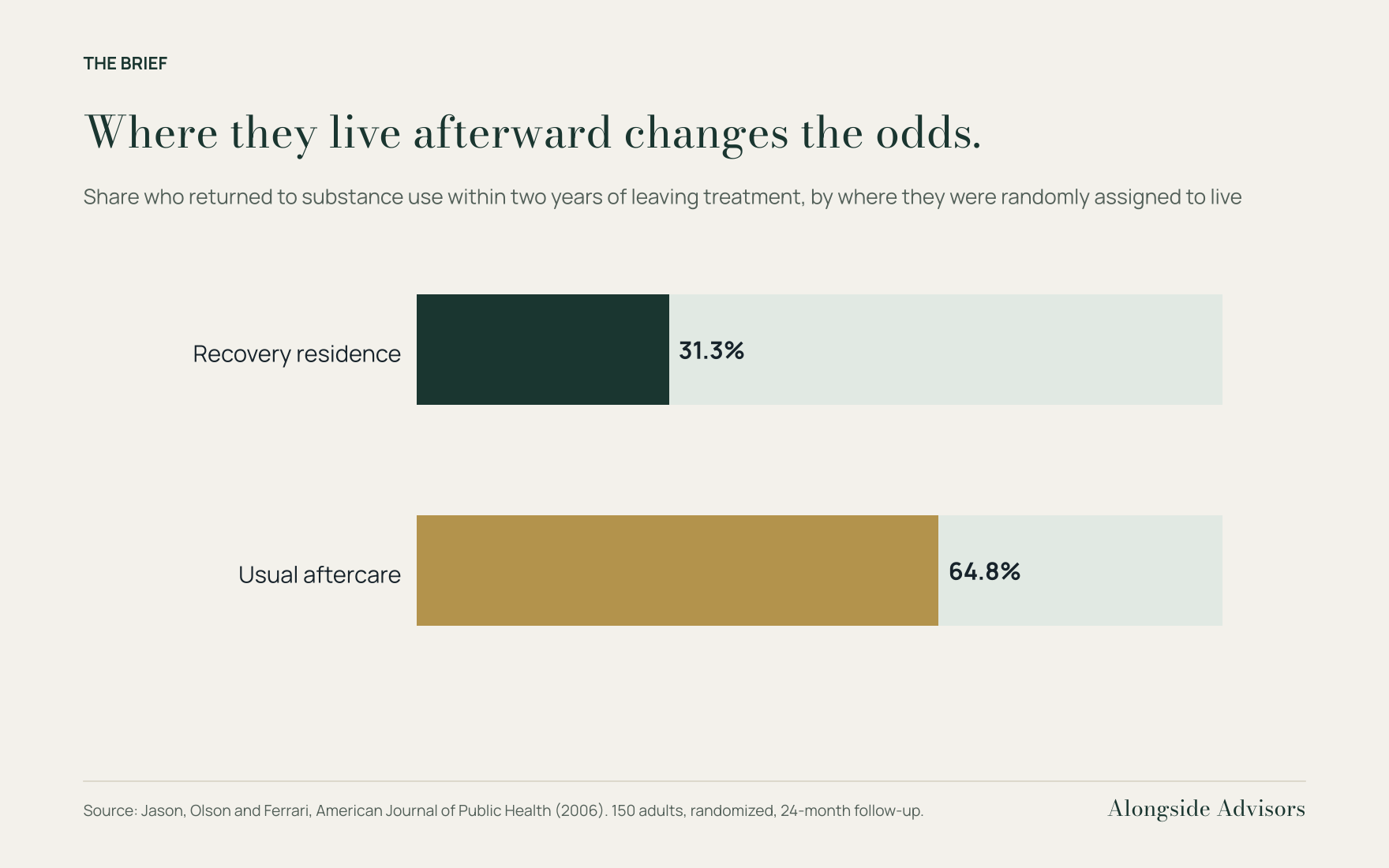
“Home for now” is the default, and sometimes it is right. It should still be an actual decision, made out loud, with the team’s input. In a randomized trial, people leaving treatment were assigned either to a recovery residence or to usual aftercare. Two years later, 31% of the recovery-residence group had returned to use, against 65% of the others, and their monthly income was more than double.
For young adults the pattern is even sharper, as Issue 01 covered: about six times the odds of staying continuously abstinent, yet only 20 to 35% go.
What a good answer sounds like
A specific place, with a reason, and a date for revisiting the decision.
With AlongsidePrivate Advisory weighs the options with the family. Personal Companions can be in the home for the first days if that is the choice.
05/Safety at homeWho in the house knows how to use naloxone?
If opioids or stimulants were involved, the first weeks home are the most dangerous ones, because tolerance has dropped and the supply is unpredictable. The fix is cheap and proven. Massachusetts communities that trained more than 100 people per 100,000 residents in overdose response had 46% lower opioid overdose death rates than communities that trained nobody.
The person most likely to be there is a family member. In a CDC review of overdose deaths among 10- to 19-year-olds, about six in ten happened at the young person’s own home, and in two-thirds of cases someone else was present.
What a good answer sounds like
A kit goes home with the client today, and every adult in the house has been shown how to use it before anyone leaves the building.
With AlongsideFamily Advisory briefs the household before discharge, and this is part of it.
06/The step-downIs this the right time to leave, and what comes next?
Sometimes this question comes up because insurance has stopped paying, or because the client wants out. Either way, ask it out loud. In the veterans study of residential programs, people who left within the first week had 49% higher odds of dying over the next two years. NIDA has said for years that treatment shorter than about three months, across whatever levels of care, rarely holds.
Nobody is saying residential has to last three months. The question is what comes after it, and whether the dates are written down.
What a good answer sounds like
A step-down plan with dates: residential, then intensive outpatient, then outpatient, and a name next to each step.
With AlongsideOngoing Coaching keeps the client inside the plan between levels of care, with advising sessions daily to weekly.
07/If there is a slipWhat happens if there is a slip, and who gets the call?
Plans tend to assume success. Ask the team to plan for the other outcome while everyone is still in the room and calm. In two randomized trials, people who got scheduled recovery check-ups after treatment went back to treatment more often when they needed it (55% against 37%), and got there about a year sooner.
A slip that gets a response in week two is a very different situation from one nobody notices until spring.
What a good answer sounds like
A written answer to three questions: how we will know, who makes the first call, and what happens next. Plus one person whose job it is to check in, on a set schedule.
With AlongsideA Lead Advisor runs the check-ins and coordinates with the family and the licensed clinicians on the team. If a slip turns into something bigger, Intervention Support is part of the same firm.
08/The family’s roleWhat is our job, and what is not?
Families usually leave treatment with one of two instructions: “be supportive” or “let him do the work.” Neither one tells you what to do on a Tuesday. The research says family involvement helps when it is structured. CRAFT, a training approach for families, gets reluctant people into treatment at two to three times the rate of Al-Anon-style support or a traditional intervention.
A 2020 meta-analysis of 16 trials found that bringing a family member into treatment produced a small but consistent extra drop in substance use, and the benefit lasted up to 18 months. Ask for the structure.
What a good answer sounds like
A defined role: what to do, what to leave alone, and a family session on the calendar after discharge, not only before it.
With AlongsideFamily Advisory gives the family that structure, with a standing conversation through the first months.
09/SourcesFifteen studies, rules and data sets behind this issue.
- Smith TE, et al. The effectiveness of discharge planning for psychiatric inpatients with varying levels of preadmission engagement in care. Psychiatric Services, 2022;73(2):149-157. Source
- Harris AHS, et al. Predictive validity of two process-of-care quality measures for residential substance use disorder treatment. Addiction Science & Clinical Practice, 2015;10:22. Source
- Kripalani S, et al. Deficits in communication and information transfer between hospital-based and primary care physicians. JAMA, 2007;297(8):831-841. Source
- U.S. Department of Health and Human Services. Fact sheet: 42 CFR Part 2 final rule, February 2024. Source
- Cole ES, et al. Outpatient follow-up and use of medications for opioid use disorder after residential treatment among Medicaid enrollees in 10 states. Drug and Alcohol Dependence, 2022;241:109670. Source
- Han B, et al. Use of medications for alcohol use disorder in the US. JAMA Psychiatry, 2021 (NIH summary). Source
- Jason LA, Olson BD, Ferrari JR, Lo Sasso AT. Communal housing settings enhance substance abuse recovery. American Journal of Public Health, 2006;96(10):1727-1729. Source
- Bergman BG, et al. The effects of continuing care on emerging adult outcomes following residential addiction treatment. Drug and Alcohol Dependence, 2015 (summary). Source
- Walley AY, et al. Opioid overdose rates and implementation of overdose education and nasal naloxone distribution in Massachusetts. BMJ, 2013;346:f174. Source
- Tanz LJ, et al. Drug overdose deaths among persons aged 10-19 years, United States, July 2019-December 2021. MMWR, 2022;71(50):1576-1582. Source
- National Institute on Drug Abuse. Principles of Drug Addiction Treatment: A Research-Based Guide, 3rd edition, 2018. Source
- Scott CK, Dennis ML. Results from two randomized clinical trials evaluating quarterly recovery management checkups. Addiction, 2009;104(6):959-971. Source
- Roozen HG, de Waart R, van der Kroft P. Community reinforcement and family training: an effective option to engage treatment-resistant substance-abusing individuals in treatment. Addiction, 2010;105(10):1729-1738. Source
- Ariss T, Fairbairn CE. The effect of significant other involvement in treatment for substance use disorders: a meta-analysis. Journal of Consulting and Clinical Psychology, 2020;88(6):526-540. Source
- Kessels RPC. Patients’ memory for medical information. Journal of the Royal Society of Medicine, 2003;96(5):219-222. Source
Free download for families
Twenty questions for the discharge meeting.
The questions above, plus twelve more, on two pages with room to write the answers. Bring it to the discharge meeting, or hand it to a family before theirs.
PDF, two pages.
Where Alongside fits
Alongside Advisors works in the gap between discharge and daily life, so the plan written in treatment is the one that actually happens. A Lead Advisor can sit in on the discharge meeting when the family wants one there, then run the handoff. Every step forward is easier with someone alongside you.
“Advisor” is a professional title, not a license, certification or registration. Alongside Advisors provides non-clinical support; clinical care comes only from licensed professionals. This article is general information, not medical advice. If you or someone you know is in crisis, call or text 988. For help finding treatment, call the SAMHSA National Helpline at 1-800-662-4357.
A private conversation
Building fulfilled lives, alongside you.
Call or text . Confidential from the first call.
Speak with an Advisor