The BriefIssue 03
Six things to do while they are in treatment.
When someone goes to treatment, the family is usually told to rest and wait. Rest, yes. But the weeks they are away are the best window the family will get to do its own work. Here is what that work is, and the research behind it.
The short version
For most people, residential treatment is short. The national median stay is 21 days in short-term residential programs and 35 in long-term ones. For the family, those weeks arrive first as relief, then as a strange quiet. The phone is not ringing at two in the morning. Someone suggests you take a break, and you should. But most of what decides how the first month home goes is settled before the drive home, and a surprising amount of it is settled by the family.
The research below says the same thing from six directions. Family members who get their own help do better, and so do the people they love. Homes that are reset before arrival are safer than homes reset after. Agreements made while everyone is calm hold up better than rules invented at midnight. Here is the list, and what each item looks like in practice.
Before you start
You are not responsible for their recovery, and you cannot do it for them. You are responsible for your own, and for the house they are coming back to. Everything below sits on your side of that line.
A note from Felipe
I have been the person in treatment, twice. The first time was 2005: a program in Minnesota, then almost two years in a halfway house in Delray Beach. It did not hold. I got sober for good in December 2013 and have stayed that way since.
One thing I understand now that nobody said to my family back then: they had a job during those weeks too, and nobody handed them one. This issue is the list I wish someone had given them.
The six things, and what each one looks like in practice
01/Your own supportGet your own support this week, not after they come home.
Addiction is a family illness in a measurable way. In a large health-system study, family members of people diagnosed with alcohol or drug problems ran up hundreds of dollars a year more in medical costs than matched families, and were more often treated for depression and for substance problems of their own. One estimate puts the number of adults worldwide affected by a relative’s addiction at around 100 million. Almost none of them are handed a plan.
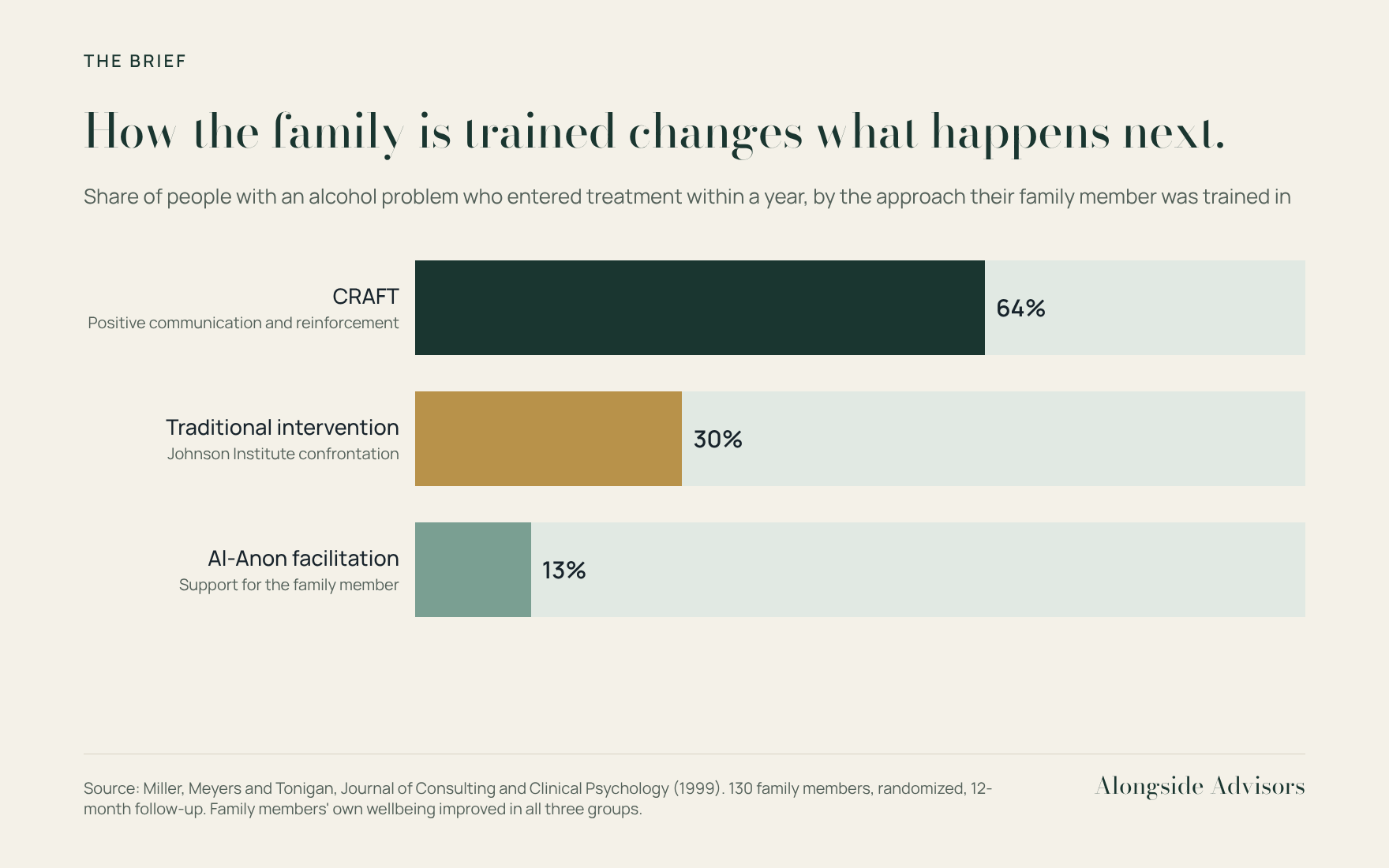
Help for the family works whether or not the person in treatment does well. In the best-known trial of family approaches, 130 family members of people who refused treatment were trained in one of three methods. The family members’ own wellbeing improved in all three groups, regardless of what the drinker did. Among Al-Anon attendees, long-standing members were more likely than newcomers to say they were satisfied with their quality of life, 50% against 39%. The pattern across the research is simple: the family that gets its own support is steadier, and a steadier family is a better place to come home to.
What it looks like
A meeting, a therapist or a family coach of your own on the calendar this week, with the second date already set. Al-Anon, Nar-Anon, SMART Recovery Family and Friends, or a CRAFT-trained clinician all count.
With AlongsideFamily Advisory gives the family its own Advisor from the first week, separate from the person in treatment, and keeps that relationship going after discharge.
02/The family programShow up for the family program and every family session.
Most residential programs offer a family weekend or a few family sessions, and families often treat them as optional. The evidence says otherwise. A 2020 meta-analysis of 16 trials found that involving a significant other in treatment produced a consistent extra reduction in substance use, and the benefit was still measurable 18 months later. In one residential program that tracked 274 patients, those whose family took part in its seven-day family program completed treatment at a rate about 10% higher than those whose family stayed away.
Family sessions are also where the hard conversations get a referee. The money, the car, the phone, who gets a key: these are easier to settle with a counselor in the room than at the kitchen table on the first night.
What it looks like
Every family session on the calendar, attended by the people who will actually live with the person. Ask for one more before discharge, and one after.
With AlongsideA Lead Advisor can join family sessions and the discharge meeting when the family wants one there, then keeps the agreements made in those rooms alive afterward.
03/The houseReset the home before they walk in, not after.
Cravings respond to cues. In a Yale study, 93 people who had completed a month of inpatient alcohol treatment were tested for how strongly reminders of drinking provoked craving, then followed for 90 days. The stronger the cue-induced craving, the sooner they relapsed, and the effect held after adjusting for everything else measured. The half-finished bottle in the pantry, the glass they always used, the drawer, the spot in the garage: these are cues. They are cheap to remove and expensive to leave.
Do it before arrival, not with them watching. If the person wants to be part of it, do it together on the first day, as something you do with them rather than an inspection.
What it looks like
Alcohol gone, including the cooking wine and the gift bottles. Medications locked away. Paraphernalia, hiding places and reminders cleared. The bedroom made up like a room they would want to come back to.
With AlongsideAn Advisor can reset the home in advance, or on the day of arrival together with the client, so nothing from before is waiting for them.
04/The agreementDecide the money, the car and the phone before the drive home, and write it down.
Behavioral couples therapy, one of the best-studied family treatments for addiction, is built around a written recovery contract: a short daily exchange in which the person states their intention to stay sober that day and the partner expresses support. In a meta-analysis of 12 randomized trials with 754 participants, adding this approach beat individual treatment on substance use and on relationship satisfaction, with the advantage on use showing up at follow-up rather than fading. The lesson travels beyond couples. Agreements that are explicit, daily and mutual hold better than rules nobody wrote down.
The questions families argue about in the first month are predictable: who holds the money, who has the car keys, whether location sharing is on, whether there is testing and who sees the result, which friends can visit. None of them get easier once the person is home. Settle them in the last two weeks of treatment, with a counselor in the room, and put a date on each one for revisiting it.
What it looks like
One page, filled in by both sides before discharge, with a 30-day review date. The download below is built for exactly this.
With AlongsideThe Home Agreement is the first thing a Lead Advisor works through with the family and the client. Then we hold everyone to it, gently and daily.
05/How we talkChange how the house talks about it.
How the household talks turns out to be one of the better predictors of relapse. In a study of 86 people in alcohol treatment, those whose spouses scored high on criticism and hostility, what researchers call expressed emotion, were more likely to relapse over the following year than those whose spouses scored low. The point is not to walk on eggshells. It is that interrogation, sarcasm and the nightly “are you sure you should” carry a measurable cost.
CRAFT, the family approach with the best engagement record, is in large part a communication course: brief, positive, specific, and about the behavior rather than the person. In the head-to-head trial, family members trained this way got a reluctant drinker into treatment 64% of the time, against 30% for a traditional confrontational intervention and 13% for Al-Anon facilitation. How the family talks changes what happens next.
What it looks like
Each person in the house names one thing they will say more often and one thing they will stop saying. Interrogation, sarcasm and “are you sure you should” go on the stop list.
With AlongsideFamily Advisory sessions teach and rehearse this, in person in South Florida and New York, or on Zoom.
06/The first monthPlan the first weekend and the first 30 days, including the slip.
The month after discharge is the riskiest one, as Issue 01 covered. The plan for it should exist before the drive home: the first appointment date, the meetings, who drives, what the first Saturday looks like. And it should include the outcome nobody wants to talk about. In two randomized trials of scheduled check-ups after treatment, people who got the check-ups returned to treatment when they needed it more often (55% against 37% in the second trial) and about a year sooner.
A slip with a plan behind it is a bad week. A slip without one can become a bad year. Decide now how you will know, who makes the first call, and what does not happen that night: no ultimatums, no big decisions, no new rules until the call has been made.
What it looks like
A calendar for the first two weeks, a named person who checks in on a schedule, and section 06 of the Home Agreement filled in before anyone leaves the building.
With AlongsideOngoing Coaching runs the check-ins. If a slip turns into something bigger, Intervention Support is part of the same firm.
07/SourcesFourteen studies, data sets and guidelines behind this issue.
- Substance Abuse and Mental Health Services Administration. Treatment Episode Data Set (TEDS) 2022: Admissions to and Discharges from Substance Use Treatment Services. Median length of stay by type of service. Source
- Ray GT, Mertens JR, Weisner C. The excess medical cost and health problems of family members of persons diagnosed with alcohol or drug problems. Medical Care, 2007;45(2):116-122. Source
- Orford J, Velleman R, Natera G, Templeton L, Copello A. Addiction in the family is a major but neglected contributor to the global burden of adult ill-health. Social Science & Medicine, 2013;78:70-77. Source
- Miller WR, Meyers RJ, Tonigan JS. Engaging the unmotivated in treatment for alcohol problems: a comparison of three strategies for intervention through family members. Journal of Consulting and Clinical Psychology, 1999;67(5):688-697. Source
- Timko C, Cronkite R, Kaskutas LA, Laudet A, Roth J, Moos RH. Al-Anon Family Groups: newcomers and members. Journal of Studies on Alcohol and Drugs, 2013;74(6):965-976. Source
- Ariss T, Fairbairn CE. The effect of significant other involvement in treatment for substance use disorders: a meta-analysis. Journal of Consulting and Clinical Psychology, 2020;88(6):526-540. Source
- McPherson C, Boyne H, Willis R. The role of family in residential treatment patient retention. International Journal of Mental Health and Addiction, 2017;15(4):933-941. Source
- Sinha R, Fox HC, Hong KA, Hansen J, Tuit K, Kreek MJ. Effects of adrenal sensitivity, stress- and cue-induced craving, and anxiety on subsequent alcohol relapse and treatment outcomes. Archives of General Psychiatry, 2011;68(9):942-952. Source
- Powers MB, Vedel E, Emmelkamp PMG. Behavioral couples therapy (BCT) for alcohol and drug use disorders: a meta-analysis. Clinical Psychology Review, 2008;28(6):952-962. Source
- O’Farrell TJ, Hooley J, Fals-Stewart W, Cutter HSG. Expressed emotion and relapse in alcoholic patients. Journal of Consulting and Clinical Psychology, 1998;66(5):744-752. Source
- Roozen HG, de Waart R, van der Kroft P. Community reinforcement and family training: an effective option to engage treatment-resistant substance-abusing individuals in treatment. Addiction, 2010;105(10):1729-1738. Source
- Scott CK, Dennis ML. Results from two randomized clinical trials evaluating the impact of quarterly recovery management checkups with adult chronic substance users. Addiction, 2009;104(6):959-971. Source
- Substance Abuse and Mental Health Services Administration. TIP 39: Substance Use Disorder Treatment and Family Therapy. Updated 2020 (PEP20-02-02-012). Source
- Timko C, Laudet A, Moos RH. Newcomers to Al-Anon family groups: who stays and who drops out? Addictive Behaviors, 2014;39(6):1042-1049. Source
Free download for families
The Home Agreement.
One page the family and the person coming home fill in together before the drive home: check-ins, money, the car and the phone, the house, testing and privacy, how we talk, what happens if there is a slip, and each person’s own support. With a 30-day review date, and a second page on how to use it.
PDF, one sheet, front and back.
Where Alongside fits
Alongside Advisors works with the family from the first call, not only with the person in treatment. The family gets its own Advisor through the whole process: preparation before treatment, support while they are away, the home reset, the first weekend, and the months after. Every step forward is easier with someone alongside you.
“Advisor” is a professional title, not a license, certification or registration. Alongside Advisors provides non-clinical support; clinical care comes only from licensed professionals. This article is general information, not medical advice. If you or someone you know is in crisis, call or text 988. For help finding treatment, call the SAMHSA National Helpline at 1-800-662-4357.
A private conversation
Building fulfilled lives, alongside you.
Call or text . Confidential from the first call.
Speak with an Advisor