The BriefIssue 04
A holiday plan for families: Thanksgiving, Chanukah or Christmas, and New Year’s.
Three holidays land inside five weeks. For a family with someone in early recovery, the holidays bring more stress than any other stretch of the year. Here is the Alongside guide on how to plan each event and each conversation so you and your loved ones can prepare ahead of time.
The short version
This year Thanksgiving falls on November 26. Chanukah starts at sundown on December 4, Christmas follows three weeks later, and New Year’s Eve closes it out. That is three major gatherings in about five weeks. Most of them are built around a table with wine on it, relatives who have not seen your person since before treatment, and a calendar of events that pushes aside the meetings, sleep and structure that have been holding things together.
Families tend to handle this by hoping. They hope the uncle does not make a comment, hope nobody pours a drink out of habit, hope that their loved one stays on track. A plan works better than hope, and it takes about an hour to make. The six steps below are the ones we would walk a family through, and the one-page Holiday Plan at the end is where you write the answers down together.
Before you start
This is a planning guide for the family’s side of the holidays. It does not replace treatment, a continuing care plan or anything your person’s clinician has asked of them or of you.
A note from Felipe
I spent my first sober Thanksgiving in treatment. On December 13 I moved from treatment into a halfway house, and I spent that Christmas there, with the people I had just started living with. They became my family for the holiday, and it was the one place I felt safe.
My parents and my family respected that. It was hard for all of us, and I know they wanted me home. But the halfway house was where I needed to be that year, and they let me be there.
Not everyone has that option. Most people in their first year are going to be at the family table, or deciding whether they can be. So this issue is about how a family can make that table a place where their person feels supported, and what to do when the honest answer is that they need to be somewhere else.
What the data says
In the American Psychological Association’s 2023 holiday survey of 2,061 adults, 89% said something about the season causes them stress and 41% said their stress goes up compared with the rest of the year. Researchers who tracked college students’ drinking week by week found large increases around Thanksgiving and across Christmas and New Year’s. And a federal analysis of drunk-driving deaths found the daily toll rose from 36 on an average day to 45 over Christmas and 54 over New Year’s.
The pressure, the alcohol and the disruption all peak together between Thanksgiving and New Year’s, and that is reason enough to plan.
The six steps, and what each one looks like in practice
01/The conversationHave the planning conversation this week, well before Thanksgiving.
The most common mistake is planning around the person when you could be planning with them. Families quietly decide to hide the wine, or to skip the party, or to tell the cousins, and the person in recovery finds out at the door. Ask first. They usually know better than anyone which rooms and which people are hard for them.
Keep it short and specific. A good opening is: “The holidays are coming up and I’d like us to plan them together. What would make Thanksgiving easier for you?” Then ask which events they want to attend, which they would rather skip, whether they want alcohol on the table, and who they want to know about their recovery. If the answer is that they need to spend the day somewhere else, at a meeting, with their sober living house or with their sponsor, treat that as a plan and help them make it.
What it looks like
One calm conversation of about thirty minutes, this week, with the Holiday Plan on the table and the person in recovery making the plan that will work for them.
With AlongsideA Family Advisor can sit down with the family to help facilitate this conversation.
02/Each eventPlan each event separately, with an arrival, an exit and a job.
The three holidays ask different things. Thanksgiving is a long seated meal, and the night before it is a big going-out night in a lot of towns, which matters if old friends are home. Chanukah and Christmas often mean houseguests, travel and several days without a normal schedule. New Year’s Eve is the one night built almost entirely around drinking, and it is perfectly reasonable to skip the party and do something else.
For each event, settle four things in advance: what time you arrive and what time you leave, whether your person has their own way home, who their point person is in the room, and what their job is. A job helps more than people expect. Someone who is carving, driving the grandparents or running the kids’ table has a reason to be on their feet and an easy answer when a drink is offered.
What it looks like
“We get there at 3, we eat at 4, we leave by 6:30. You have your own car. If you want to go sooner, text me the word ‘coffee’ and we leave, no questions.”
With AlongsideAn Advisor can attend an event with your person, be on call for the day, or travel with them when the holiday means a flight. See Personal Companions.
03/The house and the tableDecide what the house and the table will look like.
Cravings respond to cues. In a Yale study, 93 people who had finished a month of inpatient alcohol treatment were tested on how strongly reminders of drinking provoked craving and then followed for 90 days. The stronger the craving those cues produced, the sooner they relapsed. A holiday table is full of cues: the open bottle, the toast, the smell of the drink they always had.
If you are hosting, the simplest version in the first year is an alcohol-free table with something good to drink in its place. If that is not possible, keep the alcohol in one spot away from where your person will sit, and clear it when the meal ends. If you are a guest somewhere else, make a plan with your loved one about where they want to sit and who there might be a trigger for them.
What it looks like
A decision made with your person. If your loved one approves, you can call the host before the day and ask them to seat your loved one away from the alcohol.
With AlongsideAn Advisor can reset the home before guests arrive, the same way we do before someone comes home from treatment.
04/The relativesAgree on what the relatives know.
How a household talks is one of the better predictors of what happens next. In a study of 86 people in alcohol treatment, those whose spouses scored high on criticism and hostility were more likely to relapse over the following year. At a holiday table that looks like the pointed joke, the “are you sure you should be here,” or the toast to how well someone is doing in front of twenty people.
Your person decides who knows and what they are told. Once that is settled, one family member makes the calls ahead of time, and the message can be as short as: “Sam isn’t drinking. Please don’t offer, and please don’t bring it up at dinner.” Your person should also have one easy line ready for anyone who asks, such as “I’m not drinking tonight, I’ll take a seltzer.”
What it looks like
A short list of who knows, one person assigned to brief them, and a topic everyone agrees to leave alone for the day.
With AlongsideA Family Advisor can help the family practice these conversations out loud before the day, including the one with the hard relative.
05/BoundariesSet the boundaries on both sides, and say them kindly.
Boundaries run in two directions. Your person needs permission to protect their recovery: to leave early, to skip an event, to step outside and call someone. The family needs its own limits too, stated ahead of time and without threat.
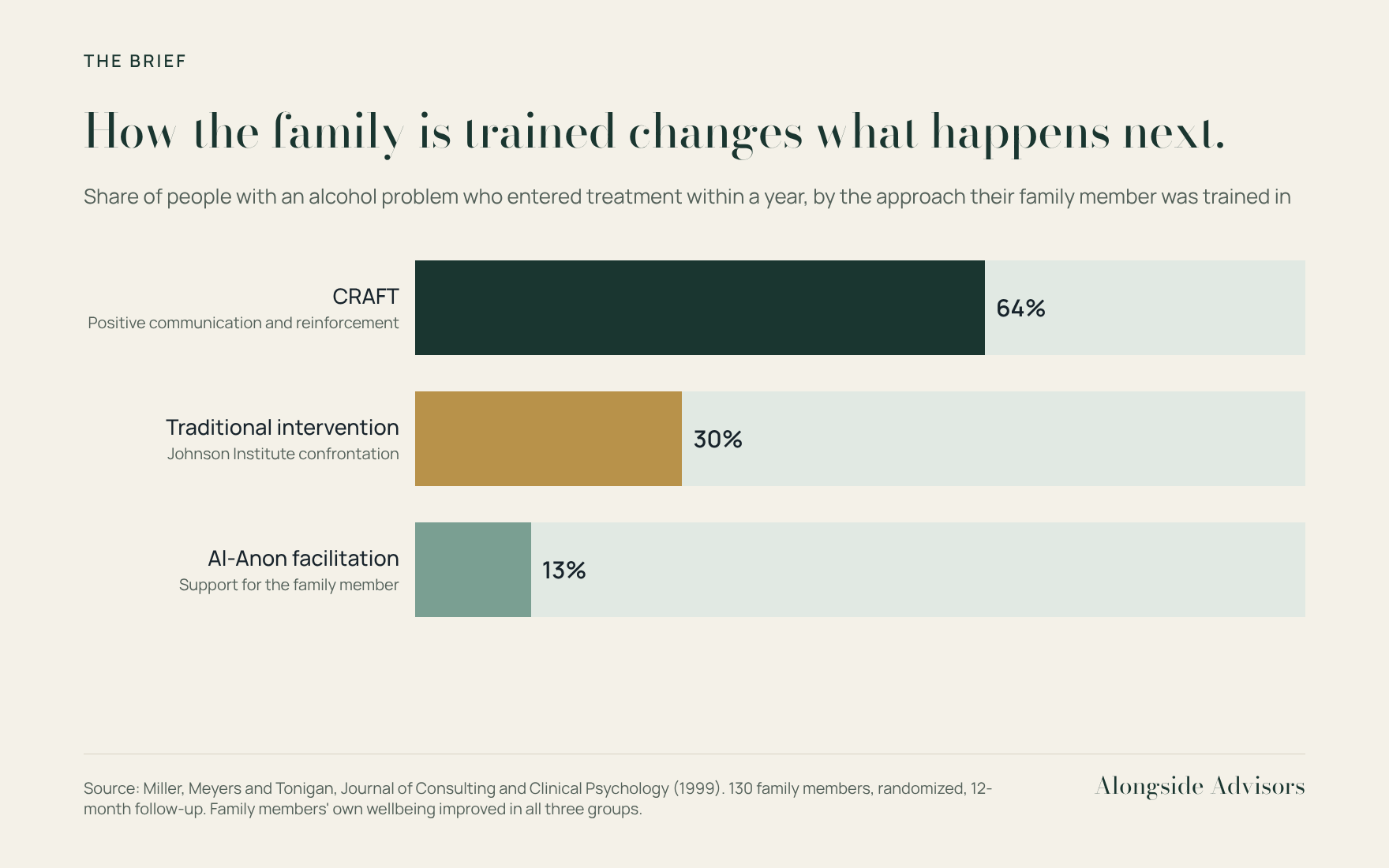
The research on family approaches points the same way on how to say them. CRAFT is a method taught to families by trained clinicians, and it is built on communication that is brief, positive and specific. In the best-known trial, family members trained in it got a reluctant loved one into treatment 64% of the time, against 30% for a confrontational intervention and 13% for Al-Anon facilitation. If you want to learn it properly, ask your person’s treatment team for a CRAFT-trained therapist.
In practice a kind boundary sounds like this. From the family: “We want you with us. If you’ve been drinking or using, we’ll ask you to come another day, and we’ll make sure you get home safely.” From your person: “I’m going to head out after dinner.” And the only reply that is needed: “I’m glad you came.”
What it looks like
Each side writes down two or three things they will do and will not do, and everyone has read them before the first event.
With AlongsideA Lead Advisor helps the family write these down and keep to them, and stays in touch with the treatment team so everyone is working from the same plan.
06/The routineProtect the routine, and plan for a slip while everyone is calm.
The days in between are where structure falls apart: doctors’ offices are closed and therapists are away on vacation. Put the replacements on the calendar now. Many recovery fellowships add meetings on the holidays themselves, and some run them around the clock. Ask the therapist now who covers while they are away. Schedule a check-in for the morning and evening of each event, and book the first appointment of January before December starts. If they are attending a 12-step program, a sponsor is an important part of this process. Sponsors are there to be a resource when someone feels a slip coming.
Then decide what happens if there is a slip. Agree on who gets the first call, who on the treatment team is called next, and what does not happen that night, which means no ultimatums and no big decisions at the dinner table.
One safety question belongs in every plan. After time without using, a return to use carries more risk than it did before. Ask your person’s treatment team what that means for your family, including whether to keep naloxone in the house.
What it looks like
A calendar from November 25 through January 2 with meetings, check-ins and appointments on it, and the slip section of the Holiday Plan filled in.
With AlongsideOngoing Advisor coaching and Advisor companions run daily through the season. If a slip turns into something bigger, we are there to help. Your Family Advisor is a resource for you, coaching you through your actions and next steps along the way. A Recovery Advisor is there for your loved one, so they feel safe and empowered, and if there is a slip their Advisor can be a sounding board. A slip does not need to ruin your holiday.
07/SourcesSeven studies, surveys and data sets behind this issue.
- American Psychological Association. Even a joyous holiday season can cause stress for most Americans. Press release, November 30, 2023. Harris Poll, 2,061 U.S. adults. Source
- Del Boca FK, Darkes J, Greenbaum PE, Goldman MS. Up close and personal: temporal variability in the drinking of individual college students during their first year. Journal of Consulting and Clinical Psychology, 2004;72(2):155-164.
- Goldman MS, Greenbaum PE, Darkes J, Brandon KO, Del Boca FK. How many versus how much: 52 weeks of alcohol consumption in emerging adults. Psychology of Addictive Behaviors, 2011;25(1):16-27. Source
- National Highway Traffic Safety Administration. Fatalities Related to Alcohol-Impaired Driving During the Christmas and New Year’s Day Holiday Periods. Traffic Safety Facts Crash Stats, DOT HS 810 870, December 2007.
- Sinha R, Fox HC, Hong KA, Hansen J, Tuit K, Kreek MJ. Effects of adrenal sensitivity, stress- and cue-induced craving, and anxiety on subsequent alcohol relapse and treatment outcomes. Archives of General Psychiatry, 2011;68(9):942-952. Source
- O’Farrell TJ, Hooley J, Fals-Stewart W, Cutter HSG. Expressed emotion and relapse in alcoholic patients. Journal of Consulting and Clinical Psychology, 1998;66(5):744-752. Source
- Miller WR, Meyers RJ, Tonigan JS. Engaging the unmotivated in treatment for alcohol problems: a comparison of three strategies for intervention through family members. Journal of Consulting and Clinical Psychology, 1999;67(5):688-697. Source
Free download for families
The Holiday Plan.
One page the family and the person in recovery fill in together before Thanksgiving: the three dates, the plan for each event, the house and the table, what the relatives know, how we talk, boundaries on both sides, the routine, and what happens if there is a slip. A second page explains how to use it.
PDF, one sheet, front and back. Clinicians and treatment teams are welcome to hand it out and use it in session.
Where Alongside fits
Alongside Advisors works with the family as well as the person in recovery. Through the holidays that can mean a planning session with a Family Advisor this week, an Advisor at the event or on call for the day, a companion for holiday travel, and daily check-ins until the new year. If you would like help making sure your loved one is safe this season, we are glad to talk it through. We are headquartered in Delray Beach, Florida, and work with families nationwide.
For clinicians and treatment teams: our work is non-clinical and sits beside yours. We help the family carry out what was agreed in your sessions, and with the client’s signed release we tell you when something changes. Every step forward is easier with someone alongside you.
“Advisor” is a professional title, not a license, certification or registration. Alongside Advisors provides non-clinical support; clinical care comes only from licensed professionals. This article is general information, not medical advice. In an emergency, call 911. If you or someone you know is in crisis, call or text 988. For help finding treatment, call the SAMHSA National Helpline at 1-800-662-4357.
A private conversation
Building fulfilled lives, alongside you.
Call or text . Confidential from the first call.
Speak with an Advisor